

Recent Blog Posts
License Revocation at Discretion of the Court
 Most moving violations do not end up with the driver being sentenced to a license revocation. In fact, even when serious bodily injury has occurred, the driver is typically allowed to drive that very same day so long as they are not seriously injured. However, in some circumstances, a court may revoke a driver’s license without a hearing, as per Illinois statute 625 ILCS 5/6-206 Discretionary authority to suspend or revoke license or permit; right to a hearing.
If a driver’s behavior falls under one of 48 different categories, they may lose their license immediately, and without a hearing, if the court believes that is the best course of action to keep other road users safe. These specific behaviors and actions include, but are not limited to, the following:
- The driver committed an offense that requires license or permit revocation upon conviction;
- The driver has been convicted of three or more moving traffic violations in any 12 month period;
Counterfeiting Counts as Theft
 A Chicago man allegedly scammed potentially dozens of people by selling them counterfeit concert tickets. He was recently caught after he sold a woman two $125 Imagine Dragon tickets on Craigslist, who took the tickets to the concert in June only to learn that they were “very good fakes,” according to the ticket checker. The woman later reported the defendant’s license plates to the police, who discovered that they were the plates of a rental car rented by the defendant’s friend and loaned to him. The defendant, who is under investigation for selling numerous counterfeit concert tickets, has five prior convictions for forgery, counterfeiting, and fraud in Texas and Illinois. A number of charges can be slapped onto those who sell counterfeit tickets.
Forgery Charges for Producing or Possessing a Counterfeit Ticket
Under Illinois statute 720 ILCS 5/17-3, forgery has been committed when a person knowingly commits any of the following:
- Makes a false document or alters a document that could be used to defraud another;
Robbery and Aggravated Robbery
 A man wearing a Teenage Ninja Turtles mask pulled his car up to the window of a drive-through pharmacy in Shiloh, Illinois and demanded a detailed list of prescription medications. He gave the pharmacist a note with instructions and said that if the pharmacist did not obey, force would be used and that there were other accomplices involved. However, before the man was delivered the medications, he drove off. Since he did not actually take anything, did a robbery occur? The short answer is yes. He can be charged with robbery, but not with theft.
You Do Not Have to Steal Anything in Order to Be Charged with Robbery
The offense of robbery is different than theft in that theft requires that something be unknowingly taken or attempted to be taken from the victim. The value of the property taken determines the level of the crime. Robbery, on the other hand, is a crime of violence and the value of goods taken or attempted to be taken has nothing to do with the level of the crime.
Lower Divorce Rate May Be Attributed to Millennial Attitudes Toward Marriage
 For decades, relationship studies suggested that couples who moved in together prior to getting married were more likely to get divorced than those who waited until after the wedding. While there may have been some truth to those numbers, they now seem to be moving in the opposite direction. Today, more couples than ever are cohabitating prior to marriage, yet the divorce rate is on the decline, and sociologists and other experts are starting to think that the two may be related.
A New Approach to Love
The generation known as the Millennials is comprised of those born roughly between the early 1980s and the late 1990s. A large number of Millennials are now in their late 20s and early 30s, and the way in which they, as a group, are approaching committed relationships much differently than their predecessors. Young people, in general, are waiting longer to get married, but they are much more likely to move in with a romantic partner than ever before.
Theft-Related Devices and Shoplifting Charges
 Retail theft is a serious crime in and of itself. Stores across the country lose billions of dollars in merchandise due to theft, and because of that laws are written to severely penalize perpetrators. In fact, retailers lost $50 billion in 2017 due to shoplifting and other forms of fraud. Shoplifting property valued up to $500 is a Class A misdemeanor, punishable by up to a year in jail, whereas theft of property valued $500 to $10,000 is a Class 4 felony, punishable by up to three years in state prison.
However, there are other offenses that you can be charged with on top of theft charges that are not related to the value of the property taken. Possession of certain theft-related devices alone can land you in jail. Theft-related tools and devices vary, but a few of the most commonly used “high tech” gadgets include fabricated keys or devices used to steal from coin-operated machines, theft detection shielding devices, theft detection removal devices, and credit card scanners or recoding devices, used to defraud the customer.
Voluntary Manslaughter Charges in Illinois
 Voluntary manslaughter is the intentional killing of an unborn child or acting in a way that would cause harm or death to an unborn child. It is not to be confused with involuntary manslaughter, which is the unintentional killing of another person, not a fetus. Voluntary manslaughter in Illinois was formerly one and the same as second-degree murder: the intentional killing of another person on-the-spot or in the heat of passion (meaning that the killing was not premeditated). However, the law currently recognizes this type of homicide simply as second-degree murder, not voluntary homicide. Today’s law is such that voluntary manslaughter is only charged when the victim is an unborn child. It is akin to second-degree murder of an unborn child, a very serious crime.
Definition of Voluntary Manslaughter
As per Illinois 720 ILCS 5/9-2.1, voluntary manslaughter is:
- Causing the death of an unborn child by acting “under a sudden and intense passion resulting from serious provocation” by another person whom the defendant tries to kill, but in so doing the defendant “negligently or accidentally causes the death of the unborn child”; or
Divorce and the Dangers of Social Media
 Since its launch in 2004, Facebook has become one of the most popular concepts in the history of the world. Recent statistics place the number of active monthly Facebook users at an astounding 2.27 billion, or more than a quarter of the world’s population. The site has become a platform for users to share details about their lives with one another in the form of text-based posts, photos, videos, and much more. Problems, however, often arise when the use of Facebook and other social media outlets continues unfettered through the divorce process.
Reality vs. Social Media
Research has long suggested that the version of one’s self that is presented to the world on Facebook, Twitter, or Instagram is frequently exaggerated. Social media users carefully construct their public image, focusing on the positive, and tending to ignore the less attractive elements of life. While most of us know at least a few people who spend most of their time on social media complaining or making vague, unhappy-sounding posts, most users project an artificially inflated social media persona that is healthier, more fun, more ambitious, and more successful than the person may be in reality.
Involuntary Manslaughter in Illinois
Involuntary manslaughter is a classification of homicide, which is the unlawful killing of another person. While first- and second-degree murder involves the intentional killing of a person, involuntary manslaughter can be thought of as an unintentional type of killing. Make no mistake; involuntary manslaughter is a serious crime, and the penalties you may be sentenced with can be harsh.
Penalties for Involuntary Manslaughter
Under Illinois 720 ILCS 5/9-3, involuntary manslaughter is the unintentional and unjustified killing of an individual when the defendant’s acts, either lawful or unlawful, are likely to cause death or serious bodily injury to another. As such, when a person performs dangerous reckless actions that result in the death of another, that person will be charged with involuntary manslaughter, unless they were operating a vehicle. As a Class 3 felony, involuntary manslaughter is punishable by up to five years in prison. Examples of actions that could lead to involuntary manslaughter include:
Traffic Fatalities on the Rise in Illinois
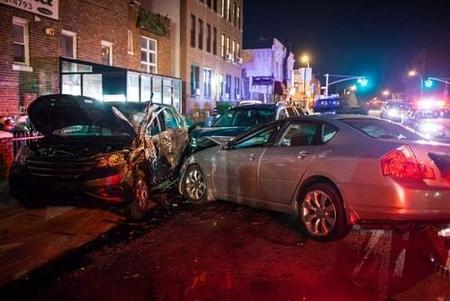 Traffic fatalities and collisions involving serious bodily injury are on the rise in Illinois and have been for the past few years, according to WTTW Public News. To be sure, 2016 was deadlier than 2015; 2017 was deadlier than 2016; and, it looks like 2018 will be deadlier than 2017, as preliminary data from the Illinois Department of Transportation shows with still over two months to go until the final numbers are in. What does this mean for drivers who have been cited with moving violations and those who have been charged with causing bodily injury or death? Because Illinois, like most states, is seeing a rise in traffic collisions, prosecutors are more likely to bring the heaviest penalties possible on those who have allegedly violated the law. Some of the most serious Illinois traffic violations include the following:
Reckless Homicide-Drivers who cause the death of another while driving in a reckless manner or in a way that is likely to cause bodily injury or death will be charged with reckless homicide. Depending on the circumstances of the collision, defendants charged with reckless homicide can be sentenced to a maximum of 28 years in prison.
Inaccuracies of Surveillance Cameras
 A suspect thought to be targeting and shooting random people in Loyola Park near Chicago is believed to live in the area after a surveillance camera spotted him walking down the street masked in black. Police believe that the man who has killed two people in the past two days has a distinctive way of walking and running, as the video surveillance points out. Police say that he walks with his feet pointing outwards, or duck-footed. While video does show the distinctive characteristic, the problem with relying heavily on this type of information is that it could lead to the arrest of the wrong person. Many people walk with their feet pointed outwards, and because the suspect’s face is fully covered, no other characteristics are visible other than his gait. Surveillance footage is typically grainy, the suspect in the footage may be in the background or partially out of the frame, and the angle of the camera may cause distortions or irregularities. On top of this, surveillance footage is often overly relied upon by jurors and is sometimes considered foolproof evidence that the defendant committed the crime.

Schedule Your Free Consultation
Arlington Heights Office 3030 Salt Creek Lane, Suite 120 Arlington Heights, IL 60005 Phone: 847-253-3100


At Cosley Law Office, we represent clients throughout Illinois, including Arlington Heights, Barrington, Buffalo Grove, Des Plaines, Elk Grove Village, Glenview, Hoffman Estates, Inverness, Long Grove, Mount Prospect, Mundelein, Northbrook, Palatine, Prospect Heights, Rolling Meadows, Schaumburg, Schiller Park, Wheeling, and Wood Dale, as well as Cook County, Lake County, DuPage County, and throughout the Chicago, IL metropolitan area.
Results listed are not a guarantee or indication of future case results.

© 2026 Cosley Law Office
3030 Salt Creek Lane, Suite 120, Arlington Heights, IL 60005
847-253-3100